Gianni Lotteringhi
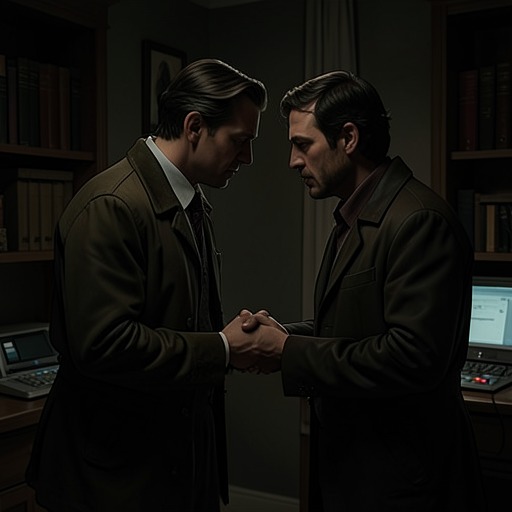
The DecameronGianni Lotteringhi is a well-to-do Florentine wool-comber, a man more successful in his trade than perceptive in private life. In the Seventh Day’s opening tale, his simplicity makes him an easy mark for his wife, Mistress Tessa: when an unexpected knock at night endangers her secret meetings with Federigo di Neri Pegolotti, she persuades Gianni that a phantom is at the door and recruits his religious habits for a comic exorcism.
Identity and Public Standing
Gianni lives in Florence, in the quarter of San Brancazio, and earns his living as a wool-comber. The tale distinguishes his competence in his craft from his judgment elsewhere: he is prosperous, but is described as simple-minded. That imbalance shapes his role. His standing in civic and religious company appears substantial, yet it does not make him discerning in his own household.
He is repeatedly chosen as captain of the Laudesi of Santa Maria Novella and also governs their confraternity. He values these offices and takes pride in the small positions he receives. His authority is therefore real within a devotional association, but the story sets that public respectability against his inability to recognize the private circumstances unfolding around him.
Devotion and Its Comic Uses
Gianni’s piety is sincere enough to govern what he keeps and what he trusts. Because he is a man of means, he gives generous portions to the clergy, including hose, gowns, and scapulars. In return, they teach him prayers and devotional pieces: the Paternoster in the vernacular, the Song of Saint Alexis, the Lamentations of Saint Bernard, and the Canticles of Madam Matilda. He treasures these writings and carefully preserves them for the health of his soul.
That collection becomes a measure of both his devotion and his gullibility. When he hears the knock, he recalls the prayers he has said before bed and the sign of the cross he has made over the bed, reasoning that these protections leave no cause for fear. The story does not need to make his faith false in order to make him ridiculous: the joke is that religious formulas give him confidence while leaving him unable to interpret the ordinary human cause of the sound.
Marriage and the Hidden Arrangement
Mistress Tessa is described as beautiful, discreet, and well-advised; she knows her husband’s simplicity and is in love with Federigo, who returns her affection. During the summer she stays at Gianni’s country house in Camerata, while Gianni comes there only from time to time, otherwise returning to his shop and his confraternity. Tessa arranges for her maid to bring Federigo to the house, where he first spends a night with her in Gianni’s absence.
The lovers then devise a signal that allows them to meet without repeatedly sending the maid. Federigo watches a vineyard beside the house for an ass’s skull set on a vine pole. With its muzzle pointed toward Florence, he can come after dark; with it turned toward Fiesole, he must stay away because Gianni is present. The skull turns the landscape into a private code, while Gianni’s movements determine whether the signal permits a meeting. The arrangement works repeatedly, and the husband remains unaware.
The Night of the Knock
On one evening when Federigo expects to sup with Tessa, she has two fat capons prepared. Gianni unexpectedly arrives late, so she serves him a piece of salt pork boiled separately and has the capons, new-laid eggs, and wine carried to a garden where she can go without passing through the house. The food is left by a peach tree, a detail that becomes central to the false exorcism she will invent. In her distraction, however, Tessa forgets to tell the maid to wait for Federigo and warn him that Gianni is there.
After Tessa, Gianni, and the maid have gone to bed, Federigo comes to the door and knocks softly. The door is close enough to the bedroom for Gianni to hear him. Tessa pretends to have been asleep, though she has heard the sound better than her husband. When Gianni mentions the knocking, she claims that a phantom has frightened her on recent nights and says she hides beneath the covers until daybreak. Her explanation converts a danger she helped create into an occasion for Gianni to display his confidence in prayers and protective gestures.
The False Exorcism and Its Reversal
Tessa proposes that they get up and exorcise the supposed phantom, claiming that an anchoress she met at the Pardon in Fiesole taught her an effective prayer. The explanation gives her a pretext to approach the door and alert Federigo to Gianni’s presence. She instructs her husband to spit when she tells him, turning his obedient participation into part of the performance.
At the door she recites a conjuration sending the phantom to the garden, to the foot of the great peach tree, where it will find the food and wine. The absurdly specific destination redirects Federigo toward the provisions without openly naming him, while the prayer’s language disguises the lovers’ practical arrangement as a supernatural remedy. Gianni spits on cue. Outside, Federigo understands that he is no longer in danger of being discovered and, despite his vexation, struggles not to laugh; under his breath he wishes that Gianni’s teeth had been the target of the spitting.
The episode closes its central trick by making Gianni’s credulity the instrument of his own deception. He believes he is protecting himself and Tessa from a phantom, when his wife is using his trust in her story—and in familiar devotional forms—to manage the arrival of her lover. The contrast between his proud religious offices and his helplessness at home gives the tale its pointed domestic comedy.